 Annual Leave Tracker
What Is Annualised Hours A Practical UK Guide

Imagine you had a work schedule that could adapt to the real world – one that ramps up when you’re swamped and eases off when things are quiet. That’s the core idea behind annualised hours.
Instead of being locked into a rigid weekly schedule, like the standard 9-to-5, an employee agrees to work a set number of hours over the entire year. It’s a bit like swapping a monthly mobile data plan for a yearly one; you get a large allowance to use whenever you need it most.
How Does an Annualised Hours Contract Actually Work?
At its heart, this system is all about aligning your team’s time with the natural rhythm of your business. Every company has its peaks and troughs. An annualised hours contract lets you plan for those busy spells without constantly resorting to expensive overtime, while also avoiding having staff with little to do during lulls.
The employee commits to a total number of working hours for the year, but their pay is usually smoothed out into 12 equal monthly payments. This gives them a predictable, stable income, even if they work 50 hours one month and 30 the next. It’s a smart way to build flexibility right into your employment contracts.
This approach is a fantastic middle ground between traditional fixed-hour roles and the unpredictability of zero-hour contracts. It's no surprise that it’s caught on in UK industries known for their seasonal swings:
- Retail: Perfect for managing the Christmas rush and the quieter post-holiday sales period.
- Manufacturing: Helps align production lines with fluctuating product demand throughout the year.
- Healthcare: A practical way to manage staffing around holidays, winter pressures, and patient flow.
- Hospitality: Essential for covering the bustling summer season and scaling back during the off-season.
The Basic Calculation
So, how do you work out the numbers? It starts with a simple calculation. For a typical full-time employee on a 40-hour week, the total gross hours would be 2,080 for the year (that’s 40 hours multiplied by 52 weeks).
But that’s just the starting point. Next, you have to subtract all paid leave entitlements to find the actual contracted working time. In the UK, the statutory minimum of 28 days of paid leave (which often includes bank holidays) works out to 224 hours for someone on a 5-day week. You’d deduct this from the gross total to get the final figure. If you want to dive deeper, you can find a detailed breakdown of how UK businesses calculate these hours and ensure compliance.
This whole approach shifts the focus from punching a clock every week to achieving a productive goal over the year. It gives employers the agility to have all hands on deck when it matters most, and employees get the peace of mind that comes with a consistent salary. It’s a strategic move away from rigid schedules towards truly responsive workforce planning.
How to Calculate Annualised Hours Correctly
Right, let's move from the theory to the practical side of things. Calculating annualised hours isn't as daunting as it might sound, especially when you break it down into a few clear steps.
Getting this calculation spot on is absolutely vital for creating a fair and legally sound contract. It means everyone – both you and your employees – is on the same page from the very beginning. This clarity prevents confusion down the line and makes your workforce planning so much easier.
The whole point is to figure out the total number of hours an employee is actually contracted to work once you've taken all their paid leave out of the equation. This final figure is what we call their net annual working hours.
This visual guide gives a great overview of how you go from the total hours in a year to the net working hours after subtracting leave.
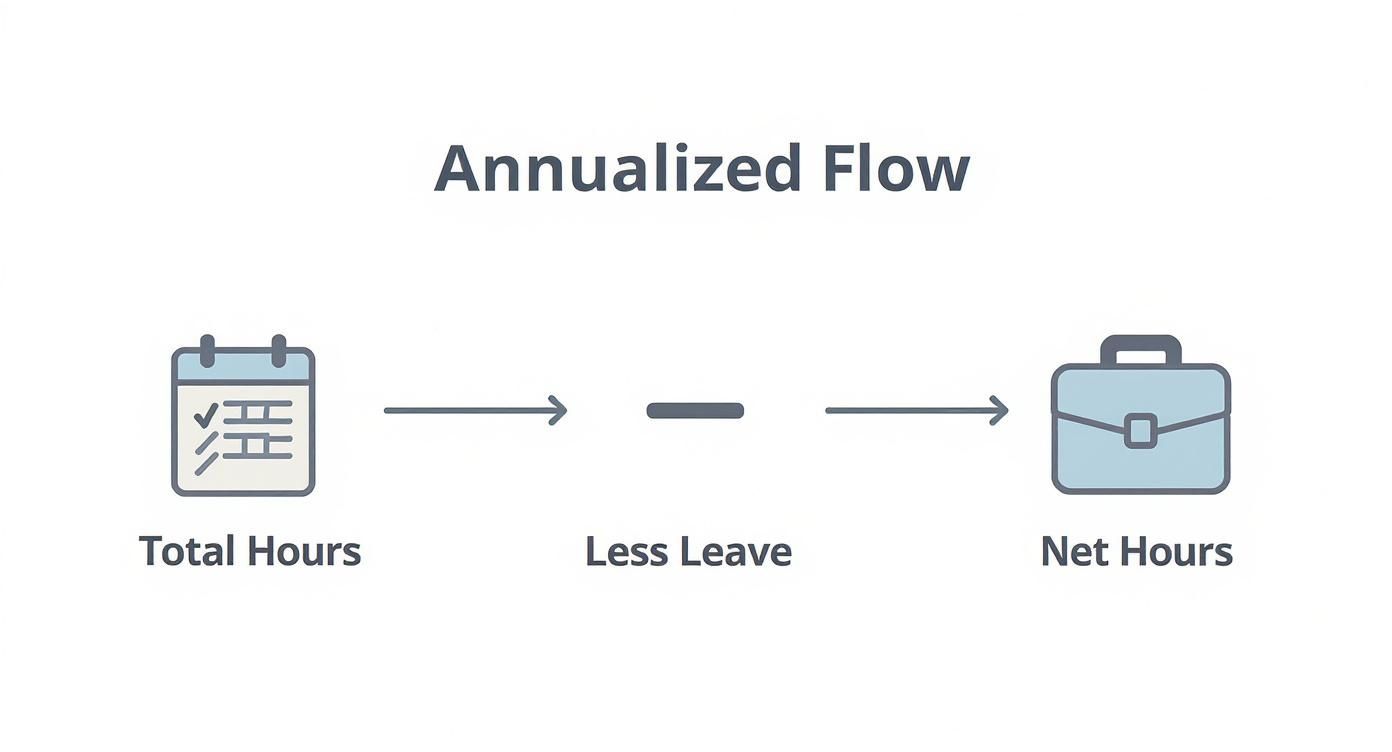
Following this process ensures the final contract hours accurately show the time an employee is expected to be working, completely separate from their paid time off.
The Basic Calculation Formula
To get started, you'll need three key bits of information: the employee's standard weekly hours, their total annual leave entitlement in days, and the length of their standard workday in hours.
The calculation itself is a simple three-step process:
- Calculate Gross Annual Hours: First, multiply the employee’s contracted weekly hours by 52 (the number of weeks in a year). This gives you the total potential hours they could work.
- Calculate Total Leave Hours: Next, multiply the employee's total paid leave days (this must include bank holidays) by the number of hours in their standard workday.
- Determine Net Annual Working Hours: Finally, subtract the total leave hours (from Step 2) from the gross annual hours (from Step 1).
Net Annual Hours = (Weekly Hours × 52) – (Total Leave Days × Daily Hours)
This final number is the magic figure – it's the total hours the employee needs to work over the 12-month period to meet their contractual obligations.
Example for a Full-Time Employee
Let's walk through a real-world example. We'll take a full-time employee who is contracted for 37.5 hours per week, working 7.5 hours per day. In the UK, they're entitled to the statutory minimum of 28 days of paid leave.
- Step 1 Gross Hours: 37.5 hours/week × 52 weeks = 1,950 hours
- Step 2 Leave Hours: 28 days × 7.5 hours/day = 210 hours
- Step 3 Net Working Hours: 1,950 hours – 210 hours = 1,740 hours
Simple as that. This employee's annualised hours contract would be for 1,740 working hours per year. If you want to dig deeper into how public holidays can affect this, our guide on the number of working days in a year in the UK is a great resource.
Example for a Part-Time Employee
The great thing is, this same logic works perfectly for part-time staff, making sure their hours are calculated fairly and proportionally.
Let’s imagine an employee who works 20 hours per week. Their standard workday is 8 hours, meaning they work 2.5 days a week. Their pro-rata holiday entitlement would be 14 days (which is 2.5/5ths of the full-time 28 days).
- Step 1 Gross Hours: 20 hours/week × 52 weeks = 1,040 hours
- Step 2 Leave Hours: 14 days × 8 hours/day = 112 hours
- Step 3 Net Working Hours: 1,040 hours – 112 hours = 928 hours
So, this part-time employee's contract would be for 928 working hours annually. It’s a straightforward way to maintain fairness and accuracy, no matter the working pattern.
The Strategic Benefits for Your Business
Switching to an annualised hours model is more than just a different way to build a rota; it's a strategic shift that lets you sync your workforce with the real-world rhythm of your business. It’s about building a more agile and resilient operation, one that can handle market shifts without the usual staffing chaos. This turns workforce management from a constant firefight into a forward-thinking plan.
The most obvious win is how it lets you match your staffing levels perfectly to fluctuating demand. Think about businesses with clear peaks and troughs—retail at Christmas, tourism in the summer, or accountancy at the end of the tax year. For them, this is a game-changer. You can schedule more hours when you're flat-out busy, without racking up expensive overtime bills or going through the pain of hiring temporary staff.
On the flip side, this flexibility means you stop paying people to stand around during quiet periods. No more overstaffing in the slow months. Instead, you can ensure you have all hands on deck precisely when you need them to serve customers and drive revenue.
Enhancing Operational Efficiency and Cost Control
Beyond smoothing out the seasonal bumps, annualised hours inject some much-needed predictability into your budget. By agreeing on a total number of hours for the year, you establish a fixed, foreseeable labour cost. This stability makes financial planning and forecasting a whole lot more accurate, saving you from the nasty surprise of a huge overtime bill.
This model also just makes day-to-day operations run better. With a pre-agreed bank of hours to work with, you can plan rotas much further in advance. This gives everyone—the business and your employees—a clearer picture of what the coming months look like, cutting down on last-minute scheduling scrambles and improving team coordination.
At its core, annualised hours help you run a leaner, more effective operation by smoothing out labour costs and aligning your team's presence with actual business demand. It’s about making sure every hour you pay for is an hour that adds genuine value.
A Smarter Way to Manage Your Team
Of course, for this all to work, you have to be meticulous about tracking hours worked against the total contracted hours. This is where modern tools are no longer a nice-to-have but an absolute necessity. A dedicated system takes the headache out of the entire process, ensuring everything is accurate and transparent for both you and your staff. For a deeper dive into how technology can help, our guide to online leave management systems has some great pointers.
When you add it all up, an annualised hours contract offers a compelling list of benefits that directly boost your bottom line:
- Reduced Overtime Costs: You drastically cut down on paying enhanced rates by scheduling the hours you need as part of the standard contract.
- Lower Recruitment Expenses: The need to hire temporary or agency staff to cover busy periods falls away, saving you a fortune in recruitment and training.
- Improved Budget Predictability: Labour costs become a stable, annual figure, not a volatile monthly expense, which makes financial planning much easier.
- Increased Productivity: Your team is on hand when they're most needed, ensuring you're maximising output and keeping customers happy during peak times.
Looking at It from the Employee's Side
An annualised hours system is only ever as good as the people working within it. While the perks for the business are pretty clear, it’s vital to get a handle on how this model actually feels for your team on the ground. The ripple effects on your employees and the overall company culture can be huge, bringing both real benefits and some tricky challenges.
For many, the biggest plus is getting a steady, predictable salary every single month. Knowing their income won't suddenly drop during a quiet patch provides a massive sense of financial security, especially when their actual working hours are all over the place. That predictability alone can take a lot of stress out of the equation compared to more volatile work setups.
This structure can also, for some, unlock a much better work-life balance. Think about it: employees might get big chunks of downtime during the off-season. This could mean longer holidays, time to focus on a personal project, or simply a chance to properly recharge, creating a different, more cyclical rhythm of work and rest across the year.
The Good, the Bad, and the Burnout
But let's be honest, that flexibility can cut both ways. While the pay packet is stable, the work schedule can be anything but. The sheer unpredictability of when they’ll be needed can make planning life—everything from a doctor's appointment to childcare or a simple night out—a real headache. This constant uncertainty can be a major source of frustration and feel incredibly disruptive.
Then there's the very real risk of burnout. During those frantic peak periods, your team could be pulling long, intense shifts for weeks or even months at a time. Even though these hours are part of the deal, that sustained pressure can easily lead to exhaustion and tank morale if you're not careful.
A successful annualised hours system hinges on a culture built on fairness and transparency. If communication is poor and management is weak, the whole model can feel exploitative, quickly eroding trust and doing serious damage to morale. The real art is in balancing the needs of the business with the wellbeing of your people.
Shaping Your Company Culture
Ultimately, the way you introduce and run an annualised hours system will define its cultural impact. Get it right, and you can build a genuine sense of partnership, with everyone pulling together to hit those peaks. Get it wrong, and you'll breed resentment.
To make it a win-win, you need to focus on a few key things:
- Plan Ahead: Give your team their rotas as far in advance as humanly possible. This gives them a fighting chance to plan their lives around work.
- Keep Talking: Maintain an open dialogue about what’s coming down the track. Let people know when the busy spells are expected and what the workload will look like.
- Share the Load: Make sure the less popular shifts and intense working periods are spread fairly across the entire team. Nothing kills morale faster than perceived favouritism.
- Check In on Wellbeing: During those crazy-busy times, make a point of checking in with your staff. Look for signs of burnout and be ready to offer support.
By making these elements a priority, you can build a system that delivers real advantages for the business and the people who make it run.
Navigating UK Employment Law and Compliance
Switching to an annualised hours system isn't just an operational shift; it means getting to grips with UK employment law to make sure you're playing by the rules. While this model offers fantastic flexibility, it’s not a blank cheque to sidestep fundamental worker protections. Getting your head around your legal duties from day one is absolutely key to protecting your business and, just as importantly, treating your team fairly.
The main piece of legislation you need to know about is the Working Time Regulations 1998. This is the rulebook that sets out the basics on working hours, rest breaks, and paid holidays. Even with a flexible annual contract, these rules are non-negotiable and need to be monitored closely to avoid any slip-ups.
It's clear this system is becoming more common across the UK. In 2024, around 2.1 million workers were on annualised hours contracts, and that number has been climbing as businesses look for smarter, more agile ways to manage staffing. This trend just goes to show how vital it is to get the legal side of things right. For a deeper dive into these numbers, you can explore the latest workforce trends on Statista.
Core Compliance Checklist
To make sure your contracts are solid and legally sound, there are a few areas you absolutely have to cover. Think of these as the non-negotiables that protect everyone involved.
- The 48-Hour Week: On average, an employee can't work more than 48 hours per week. This is usually calculated over a 17-week reference period. You’ll need to track hours like a hawk to ensure that even during your busiest times, you don't breach this average—unless an employee has voluntarily signed an opt-out agreement.
- Rest Breaks: People are legally entitled to an uninterrupted 20-minute break if they work for more than six hours. They also need 11 hours of rest between shifts and one whole day off each week. Your rotas have to be planned with these mandatory rest periods baked in.
- National Minimum Wage (NMW): This is a big one. Even though their salary is spread evenly across the year, an employee’s pay for any single pay period must never drop below the National Minimum Wage for the hours they actually worked in that time. Meticulous record-keeping is your best friend here, especially in those months where they're putting in lots of extra hours.
Your employment contract is the foundation of the whole arrangement. It must clearly spell out the total annual hours, how pay is calculated, the rules for any overtime, and what happens if someone leaves part-way through the year. Any grey areas here are just asking for trouble down the line.
Holiday Pay and Entitlements
Holiday pay is another area that needs careful handling. Your team members on annualised hours are still entitled to their statutory minimum of 5.6 weeks of paid holiday each year.
The tricky part is figuring out how much to pay them for that time off, since their working hours can vary so much. A week's holiday pay is typically based on their average weekly earnings over the previous 52 weeks. For a detailed walkthrough, take a look at our practical guide on how to calculate holiday pay in the UK. Getting this right is a cornerstone of fair and compliant leave management.
Got Questions About Annualised Hours?
Even when you've got the basics down, the day-to-day reality of managing annualised hours can throw up some tricky situations. It’s one thing to understand the theory, but another to handle it when an employee leaves halfway through the year or a busy spell demands extra work.
Getting ahead of these common questions with clear, fair policies is the best way to keep things running smoothly. Let's walk through some of the most frequent queries that crop up.
How Do We Handle Overtime?
One of the big selling points of annualised hours is that it smooths out the peaks and troughs, often reducing the need for traditional overtime. But what happens when you have a genuinely exceptional period and someone has to work beyond their total for the year?
In this system, overtime isn't a weekly or monthly affair. It only kicks in once an employee has worked all of their contracted hours for the entire year. So, if their contract is for 1,900 hours, overtime pay is only triggered on hour 1,901.
Many businesses build in a small bank of 'reserve hours' to provide a buffer for busy spells before formal overtime begins. Once an employee does exceed their annual total, those extra hours must be paid. This is usually at an enhanced rate, like 1.5 times their standard pay, but the exact figure must be clearly stated in their contract. A written policy on how extra hours get approved and paid is absolutely essential to avoid any confusion down the line.
What Happens if Someone Leaves Mid-Year?
When an employee leaves before their 12-month contract is up, you'll need to do a final calculation to settle their pay. It's a simple reconciliation to see if the hours they've been paid for match the hours they've actually worked.
First, figure out their pro-rata contracted hours up to their leaving date. Then, compare that number with the hours they actually put in.
- If they worked more than they were paid for, you'll owe them the difference in their final pay packet.
- If they worked less than they were paid for, you might be able to reclaim the overpayment from their final salary.
Be very careful with this last point. You can only deduct an overpayment if a specific clause in their employment contract explicitly gives you the right to do so. Without that wording, you could find yourself in a sticky legal situation.
How Does Sick Leave Fit into This?
Dealing with sickness is actually quite straightforward. If an employee is off sick, the hours they were scheduled to work during their absence are simply counted towards their annual total, just as if they'd been present.
This is a crucial point of fairness. It means they don't have the stress of "making up" hours looming over them when they return. Their focus should be on getting better, not on falling behind.
Their pay during this time will depend on your company’s sick pay policy, whether that's Statutory Sick Pay (SSP) or a more generous company scheme. The guiding principle is simple: genuine illness shouldn't put an employee on the back foot with their annual hours.
Can We Force an Employee to Switch to an Annualised Hours Contract?
In a word: no. You can't just change an existing employee's contract to an annualised hours system without their consent. It’s a fundamental change to their terms and conditions of employment.
To make this kind of switch, you have to go through a proper consultation process. You need to explain the proposal clearly and get their full agreement to the new terms. For new starters, of course, it's a different story – you can simply make annualised hours a standard part of their contract from the beginning.
Managing annualised hours, sickness, and holidays doesn't have to be a constant struggle with spreadsheets. Annual Leave Tracker gives you the simple tools you need to track everything accurately and keep your team in the loop. Discover how our software can simplify your absence management today.
Ready to Transform Your Leave Management?
Join 500+ companies using Annual Leave Tracker to streamline their HR processes.
Related Articles

How to Calculate Pro Rata Holidays A Simple UK Guide
Working out pro rata holidays is actually quite straightforward. At its core, it's just about making...
September 24, 2025
How to Calculate Annual Leave Entitlement: UK Guide
Figuring out annual leave entitlement doesn't have to be complicated. The basic formula is simple:...
September 24, 2025
HR Systems for Small Business A Complete Guide
Trying to run a small business using spreadsheets and a jumble of different documents is a bit like...
September 25, 2025