 Annual Leave Tracker
How Many Working Days in a Year in the UK?
If you work a standard five-day week in the UK, you're looking at roughly 253 working days in a typical year and 254 in a leap year. This number isn't just pulled out of thin air; it’s what you get when you subtract all the weekends and bank holidays from the calendar year.
How Many Working Days Are in a Year in the UK?
Ever found yourself daydreaming about your next holiday, trying to figure out how many work days are left until you're free? You're not alone. But knowing the number of working days in a year is more than just a way to fuel your holiday countdown—it's crucial for businesses planning projects and for anyone trying to calculate their annual leave.
The basic maths is pretty straightforward. You start with the total number of days in the year and then simply take away all the days you aren't expected to be at work.
For most people, that means subtracting all the Saturdays and Sundays, plus the official bank holidays. This gives businesses and employees a clear baseline for everything from payroll runs to resource planning.
So, let's break it down. A normal year has 365 days. Out of those, you'll have 104 weekend days (that’s 52 Saturdays and 52 Sundays). On top of that, England and Wales have 8 bank holidays as standard. Do the subtraction, and you land on 253 working days.
Of course, a leap year throws a small spanner in the works by adding an extra day, bringing the total to 254 working days. While this is a solid starting point, the final number can shift depending on where you are in the UK and your specific contract. You can find more detailed guides on annual work day calculations on timetastic.co.uk.
To give you a clearer picture, here’s a simple table showing how it all adds up for someone working a Monday-to-Friday schedule.
UK Working Days At a Glance
This table shows the standard calculation for working days in both a typical and leap year in the UK.
| Calculation Component | Standard Year | Leap Year |
|---|---|---|
| Total Days in the Year | 365 | 366 |
| Weekend Days (104) | -104 | -104 |
| Bank Holidays (8) | -8 | -8 |
| Total Working Days | 253 | 254 |
As you can see, once you strip out the weekends and public holidays, the number of days you're actually expected to work becomes much clearer.
Breaking Down the Annual Working Day Calculation
Figuring out the number of working days in a year is really just a process of elimination. Imagine you start with all 365 days on the calendar. From there, you just start taking away all the days you won't be working.
The biggest chunk to go, of course, is the weekends. A standard year has 52 full weeks, which means 52 Saturdays and 52 Sundays. That’s 104 weekend days off the table right from the start, bringing our initial 365 days down to a more realistic 261.
This simple visualisation shows how you get from the total days in a year down to your potential working days.
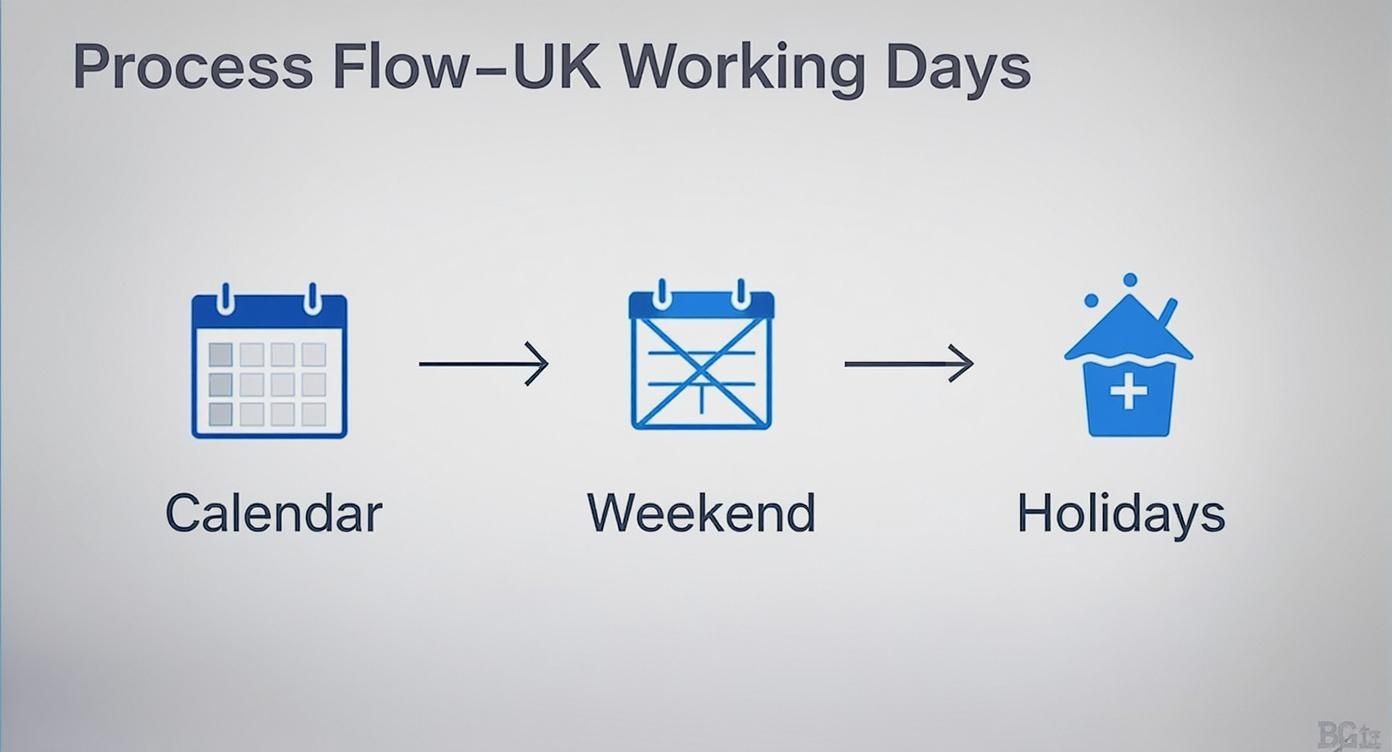
As you can see, once you’ve taken out the weekends, the next step is to account for public holidays to find your final number.
Subtracting UK Bank Holidays
With the weekends out of the way, we next need to deduct bank holidays. In England and Wales, we usually get eight of them each year. These are national days off, so they come straight out of the total.
Taking those 8 bank holidays away from our 261 days leaves us with the magic number: 253 working days.
This baseline of 253 days is the figure you’ll see underpinning most full-time employment contracts in the UK. It’s the starting point for everything from planning project schedules to working out annual leave.
It's worth remembering that Scotland and Northern Ireland have their own bank holiday calendars, so their final tallies might differ slightly. While this calculation gives you that solid baseline, an individual's actual time in the office will depend on their personal holiday allowance. If you want to dive deeper, have a look at our guide on using a holiday entitlement calculator for the UK.
So, the fundamental formula is beautifully simple:
- 365 Days (Total days in a year)
- Minus 104 Days (Weekends)
- Minus 8 Days (Bank holidays)
- Equals 253 Working Days
This straightforward bit of maths gives you that clear, reliable number that helps businesses plan their entire year.
How Your Work Schedule Changes Everything
The standard five-day week gives us a handy baseline for figuring out the number of working days in a year, but let's be honest, that model doesn't fit everyone anymore. Your personal work pattern is the single biggest factor that will shift this number, moving you away from that standard 253-day count.
Today’s workplaces are far more varied than the old Monday-to-Friday structure. Think of part-time staff, people on compressed four-day weeks, or freelancers whose schedules can change week to week. For them, the annual working day count looks completely different.
This is exactly why a one-size-fits-all number just doesn't work when you're calculating holiday leave or planning team resources. Every unique schedule needs its own calculation to keep things fair and accurate.
Calculating For Part-Time and Flexible Work
If you work anything less than five days a week, your working days need to be calculated on a pro-rata basis. It sounds complicated, but it's really just about adjusting the full-time total to match the hours you actually work. It’s the fairest way to make sure everyone's entitlements are proportional.
Take someone who works three days a week. They don't have 253 working days in their year. Their annual total is much lower, which directly affects their holiday allowance and how their availability is logged for team projects. It's a simple but vital concept for both employees and managers to get their heads around.
The core principle is straightforward: your working days are a fraction of the full-time equivalent. An employee on a three-day week works 60% of a standard full-time schedule (3 ÷ 5), so they have 60% of the total working days.
The same logic applies across the board. Someone on a four-day week is working 80% of the standard schedule. If you need to crunch these numbers yourself, our simple UK guide on how to calculate pro-rata holidays breaks it down step-by-step.
Getting these differences right is fundamental for accurate resource planning and ensuring every team member gets the correct holiday entitlement, no matter what their working pattern looks like.
Comparing Annual Working Days by Schedule
To see how this plays out in the real world, here’s a quick comparison of how different work patterns affect the total number of working days in a year for someone in the UK.
| Work Pattern | Days Worked Per Week | Approximate Annual Working Days |
|---|---|---|
| Standard Full-Time | 5 days | 253 |
| Compressed Week | 4 days | 202 |
| Part-Time | 3 days | 152 |
| Part-Time | 2 days | 101 |
| Part-Time | 1 day | 51 |
As you can see, the final number changes dramatically based on the days worked. This is why personalised calculations are so important for both fairness and legal compliance.
Why This Number Is So Important for Your Career and Business
Figuring out the exact number of working days in a year might sound like a bit of admin trivia, but it’s one of those numbers that quietly powers a huge range of decisions in the professional world. Think of it less as a random fact and more as a fundamental piece of data that affects everything from your personal finances to massive corporate projects.
For employees, this number is your first line of defence in making sure your pay is right, particularly if you're on a pro-rata contract. It’s also the key to understanding your holiday allowance and confirming you’re getting all the paid leave you're entitled to. Without it, you're essentially guessing.
How It Shapes Business Operations
For any business, from a small startup to a large corporation, the annual working day count is non-negotiable. It’s the bedrock for running a smooth operation. If that number is off, you can quickly see a domino effect of problems in payroll, resource planning, and project management.
Here’s why getting it right is so critical:
- Financial Planning: It’s the basis for setting salary budgets and forecasting what labour costs will look like for the financial year.
- Project Management: A project manager needs this number to calculate the total "person-days" available for a project. It’s the difference between setting an achievable deadline and setting your team up for burnout.
- Legal Compliance: It ensures the business is meeting its legal duties for statutory holiday entitlement, especially for part-time staff whose allowance can be tricky to calculate.
At its core, knowing how many working days in a year you have is all about managing your resources effectively. It helps a business understand its true capacity and plan everything around its most important asset: its people's time.
The Freelancer's Lifeline
If this number is important for employees and businesses, it's absolutely vital for freelancers and contractors. For a self-employed professional, this figure isn't just for planning—it’s the entire foundation of their business model.
A freelancer uses their total available working days to set a day rate that actually covers their take-home pay, business overheads, tax, and pension contributions. Getting this calculation wrong is often the difference between running a profitable, sustainable business and just scraping by. It allows them to accurately forecast their annual income, plan for holidays, and build a buffer for those inevitable quiet periods between contracts.
The Difference Between Contracted and Actual Days Worked
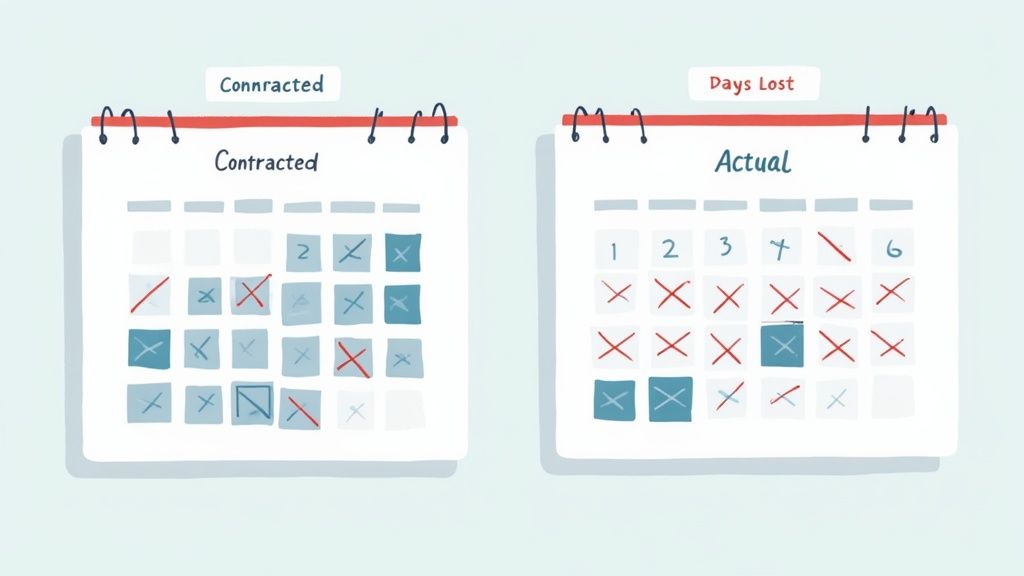
When you look at an employment contract, you’ll often see a neat figure like 253 working days. This number is your theoretical working year—it’s what’s left after you subtract weekends and bank holidays from the calendar. It’s a clean starting point, but it's rarely the full story.
The reality on the ground is almost always different. There’s a noticeable gap between this contracted number and the actual days you or your team spend at work. This is where theory meets the practical, messy reality of life.
Understanding this difference is absolutely critical for smart business planning. The contracted total doesn't factor in sick days, personal emergencies, or any other unplanned time off that inevitably happens.
The Impact of Sickness Absence on Working Days
Sickness is easily one of the biggest reasons for the gap between planned and actual working days. It's just an unavoidable part of managing people, and its impact across the UK is huge.
To put it into perspective, recent data from the Health and Safety Executive showed that a staggering 33.7 million working days were lost in Great Britain during 2023/24 due to ill health and workplace injuries. That figure alone shows how quickly the on-paper total can shrink. You can dig into the official statistics on work-related absences from the HSE to see the full picture.
This gap between contracted and actual working days isn't just an administrative detail; it’s a direct reflection of workforce health and a key indicator for business productivity.
For managers, this highlights why supporting employee wellbeing is just as important as tracking leave. For employees, it's a good reminder that your year is made up of both planned holidays and unplanned absences. Getting to grips with your UK holiday rights and what statutory annual leave means is the perfect first step to managing your time off effectively.
A Brief History of the British Work Week
It’s easy to take the Monday-to-Friday work week for granted, but it’s actually a pretty modern invention. To really get why we calculate working days the way we do, it helps to peek back in time. This schedule wasn't just given to us; it was hard-won over many, many years.
Go back a couple of centuries, and the idea of a "weekend" would have sounded like a fantasy to most people. During the Industrial Revolution, brutal work schedules were just a fact of life. Most people were putting in six days a week, often for more than ten hours a day, with almost no official time off.
The Fight for the Weekend
So, where did our beloved weekend come from? We have labour unions and social reformers to thank for it. They campaigned relentlessly for better working conditions and shorter hours, making the powerful argument that people needed proper time for rest, family, and leisure to be both productive and healthy.
This movement started to gain traction, and by the early 20th century, the Saturday half-day became more common. Over time, that slowly evolved into the full two-day weekend we have today. The whole concept of "working days" is a direct result of these landmark social reforms.
It's worth remembering this history because it reminds us that our work-life balance isn't a happy accident. It’s the product of a long, difficult journey toward recognising that rest isn't a luxury—it's essential.
If you think your work schedule is demanding, imagine what it was like back in the 1750s. With economic pressures mounting and very few formal holidays, it wasn't unusual for people to work nearly 300 days a year. You can read more about the historical changes in working hours from the Federal Reserve Bank of St. Louis to get the full picture.
Frequently Asked Questions
It’s clear that figuring out your exact number of working days isn't always a simple case of subtracting weekends. There are a few variables at play.
Let's tackle some of the most common questions that pop up, so you can feel confident whether you're an employee checking your holiday allowance or a manager planning for the year ahead.
Are Bank Holidays Included in My Annual Leave?
This is probably the most frequent question we hear, and the short answer is: it depends on your contract.
UK law gives full-time employees a right to 5.6 weeks of paid holiday. Your employer can choose to count the bank holidays as part of this entitlement, or they can give them to you on top. It’s their call.
The key is to check your employment contract. If it says you get "28 days holiday including bank holidays," then they’re already baked into your allowance. But if it says "20 days holiday plus bank holidays," then you get those as extra days off.
How Do I Calculate Working Days for a Part-Time Employee?
For part-timers, fairness is key. The easiest and most common way to work this out is on a pro-rata basis, which just means you scale everything down proportionally from the full-time equivalent.
Imagine a full-time role has 253 working days a year (based on a 5-day week). If you have a team member who works three days a week, their calculation would look like this: (3 ÷ 5) x 253 = 151.8. You’d round that up to 152 working days. This is the starting point before you account for their own pro-rata holiday entitlement.
Does the Number of Working Days Vary Across the UK?
It does, but only slightly. The difference comes down to the bank holiday calendars in each country. While most days overlap, a few unique holidays can shift the final count by a day or two.
- England and Wales follow the same calendar with eight bank holidays.
- Scotland has its own days, such as St. Andrew's Day.
- Northern Ireland observes holidays like St. Patrick's Day.
Because of this, the total number of working days in a year for someone in Glasgow might be a little different from their colleague in Cardiff.
Trying to manage all these different work patterns and leave entitlements by hand can get complicated, fast. With the right tools, you can automate these calculations and get rid of the guesswork. An Annual Leave Tracker can handle everything from pro-rata allowances to tracking different bank holiday schedules, giving you a crystal-clear view of your team's availability. Start your free trial today and see how easy it can be.
Ready to Transform Your Leave Management?
Join 500+ companies using Annual Leave Tracker to streamline their HR processes.
Related Articles

How to Calculate Pro Rata Holidays A Simple UK Guide
Working out pro rata holidays is actually quite straightforward. At its core, it's just about making...
September 24, 2025
How to Calculate Annual Leave Entitlement: UK Guide
Figuring out annual leave entitlement doesn't have to be complicated. The basic formula is simple:...
September 24, 2025
HR Systems for Small Business A Complete Guide
Trying to run a small business using spreadsheets and a jumble of different documents is a bit like...
September 25, 2025