 Annual Leave Tracker
What Is Statutory Annual Leave? Your UK Holiday Rights
When we talk about statutory annual leave, we're talking about the absolute minimum paid holiday that nearly every worker in the UK is entitled to by law. It’s a foundational right, put in place to make sure everyone gets a proper, paid break from their job to rest and recharge.
Getting to Grips with Your Holiday Entitlement

It’s best to think of your statutory annual leave not as a company benefit, but as a legally protected period for you to switch off. This isn't just good practice; it's a right enshrined in the Working Time Regulations 1998, designed to protect employee wellbeing and prevent burnout.
So, what does this look like in practice? The legal minimum is 5.6 weeks of paid holiday each year. The reason it’s defined in 'weeks' is to make it fair for everyone, whether you work a standard nine-to-five or have a more varied schedule.
For someone working a typical five-day week, this works out to 28 days of paid time off (5.6 weeks x 5 days = 28 days).
What About Bank Holidays?
This is a classic source of confusion. Do bank holidays count towards your leave? It depends entirely on your employer. They have two main options for handling the eight bank holidays in England and Wales:
- They can include them within your statutory 28 days.
- They can give you them as extra paid days off on top of your 28 days.
There's no automatic legal right to take bank holidays off. The critical thing is that your total paid leave adds up to at least 28 days (or the pro-rata equivalent).
To put it simply, here’s a quick summary of the basic rules.
Statutory Annual Leave at a Glance
| Component | UK Statutory Minimum |
|---|---|
| Total Entitlement | 5.6 weeks per year |
| Full-Time (5-day week) | 28 days per year |
| Bank Holidays | Can be included in the 28 days |
| Pay | Must be paid at your normal rate |
Ultimately, these regulations establish a fair and consistent baseline for all UK workers.
The core principle is fairness. The law ensures that everyone, from full-time office staff to part-time retail workers, receives a proportional amount of paid rest. This safeguards health and helps maintain a healthy work-life balance.
What if I'm Part-Time or on Irregular Hours?
This right isn’t just for full-time employees. The UK's framework is built to ensure part-time workers get the same entitlement, just on a pro-rata basis. This means your holiday is calculated in proportion to the days or hours you actually work, preventing anyone from being penalised for their working pattern.
If your hours are less predictable, you can find more specific guidance in our post on understanding holiday entitlement on a zero-hour contract.
The statutory rules guarantee that all eligible workers receive this minimum level of paid leave, creating a standard baseline that applies across every industry in the country. You can find more detail about specific annual leave rules in the UK on vacationtracker.io.
Getting Your Holiday Calculations Right
Knowing about the 5.6-week rule is one thing, but figuring out what that means for your specific work schedule is where it gets real. Calculating statutory annual leave doesn't need to be a headache, but the maths does change depending on how you're employed. Let's walk through the most common scenarios.
For someone working a standard full-time, five-day week, the calculation is as simple as it gets. You just multiply the statutory weeks by your work days.
5.6 weeks x 5 days a week = 28 days of paid holiday.
It's important to remember that this 28-day figure is the statutory maximum. Even if an employee works six or seven days a week, the legal minimum paid holiday they're entitled to is capped at 28 days.
Calculating for Part-Time Workers
When it comes to your part-time staff, everything works on a pro-rata basis to keep things fair. Their holiday entitlement is simply a proportion of what a full-timer gets.
For instance, if you have an employee who works a regular three days per week, their calculation looks like this:
5.6 weeks x 3 days a week = 16.8 days of paid holiday.
Most employers would round this up to the nearest half or full day, giving the employee 17 days of annual leave for the year. It's a common and sensible practice.
This infographic gives a great visual of how a full-time employee's leave entitlement builds up over the year before they put in a request.
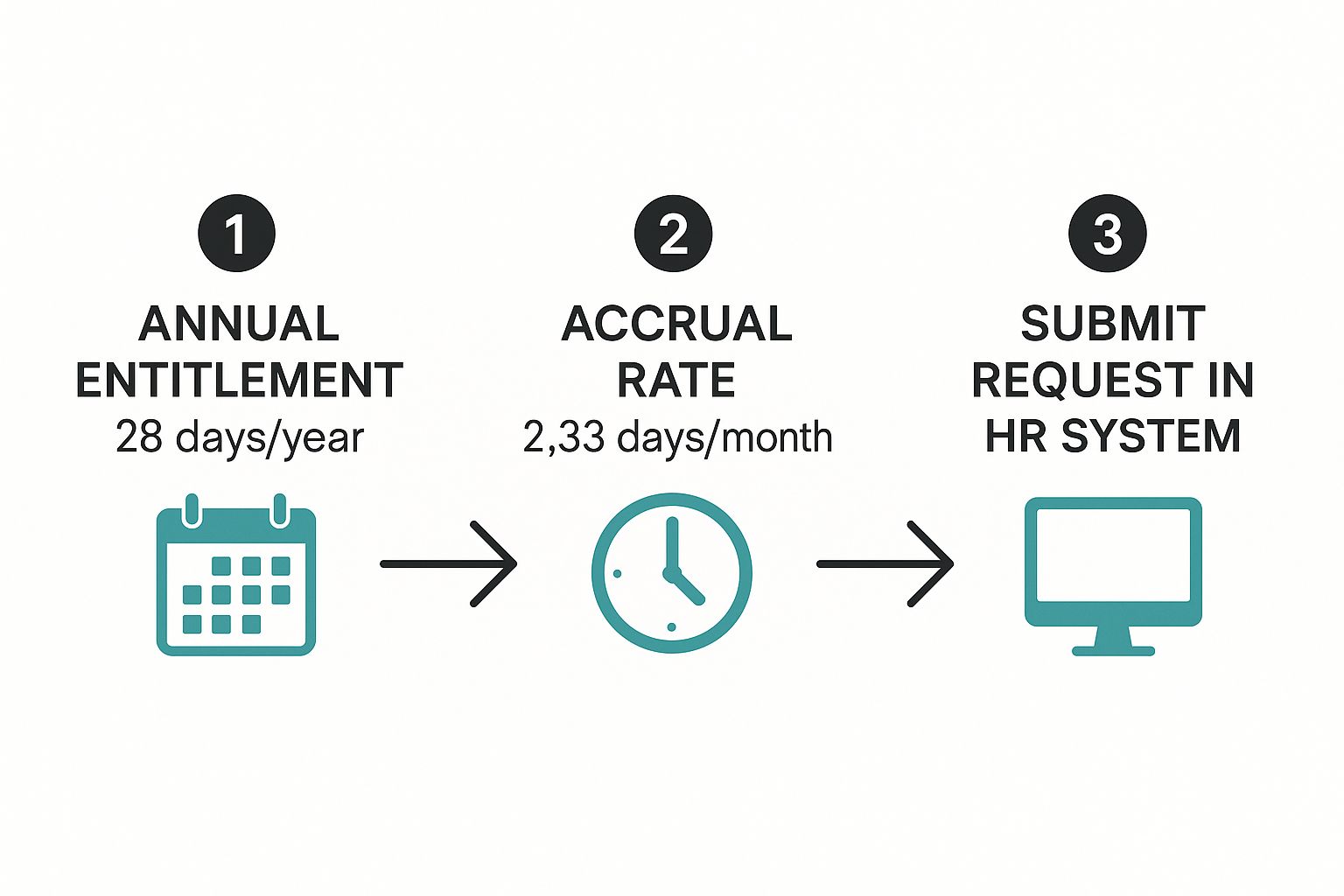
As you can see, the 28-day entitlement for a full-timer accrues at a rate of about 2.33 days for every month they work.
Leave for Irregular Hours and New Starters
Things get a bit trickier for workers with irregular hours, like those on zero-hours contracts. You can't just multiply by a set number of days. For these situations, the government's guidance points towards a percentage-based system.
Holiday entitlement for staff on irregular hours is calculated at 12.07% of the hours they've actually worked. This figure comes from a simple bit of maths: the 5.6 weeks of leave is divided by the remaining 46.4 working weeks of the year (5.6 ÷ 46.4 ≈ 12.07%).
So, if someone on a zero-hours contract puts in 100 hours in a month, they’ve earned 12.07 hours of paid holiday for that period.
What about when someone new joins the team? During their first year, their holiday entitlement accrues month by month. Essentially, they earn one-twelfth of their total annual entitlement for each full month they're with you. For a much deeper dive into the calculations for all sorts of work patterns, check out our guide on how to calculate annual leave entitlement in the UK.
Your Rights and Your Employer's Responsibilities
Knowing how much holiday you're entitled to is one thing, but understanding the rules of the road is another. The whole system is a balance between your right to rest and your employer's need to keep the business running smoothly. Fortunately, there's a clear legal framework that sets out responsibilities for everyone involved.
As an employee, your rights are clear-cut. You have the right to request your holiday, and when you take it, you must get your normal pay. It's important to remember this isn't just about your basic salary; it should also reflect any regular overtime or commission you typically earn.
Crucially, you're also protected from being treated unfairly just for asking for or taking the leave you're legally owed. This protection means you can book your time off without worrying about any negative comeback.
The Employer's Legal Duties
From the employer's perspective, managing annual leave goes far beyond simply ticking days off on a calendar. They have specific legal obligations to meet, ensuring the entire process is fair, transparent, and in line with UK law.
An employer’s core duties boil down to a few key things:
- Considering Requests Fairly: An employer can say no to a holiday request, but they can't do it on a whim. They need a solid business reason, like too many people asking for the same popular week or not having enough cover during a critical project.
- Giving Proper Notice: If an employer needs to cancel leave you've already booked, or if they want you to take holiday at a certain time (like for a Christmas shutdown), they have to give you enough warning. The general rule is they must provide notice that is at least double the length of the leave in question. So, for a one-week holiday, they need to give you two weeks' notice.
Your statutory annual leave is a protected right, not a discretionary perk. The legal framework ensures that employers manage this entitlement responsibly, from paying you correctly to handling requests in a fair and predictable manner.
These responsibilities create a system that respects both the needs of the business and your fundamental right to take paid time off.
Rules for Carrying Over and Cashing Out
So, what happens if you get to the end of the year with holiday days left over? The rules around carrying over leave are quite specific. You're generally allowed to carry over a maximum of 1.6 weeks (that's eight days for someone working full-time) into the next holiday year, but this has to be based on a written agreement with your employer.
However, the first four weeks of your statutory leave are a "use it or lose it" deal. You can't carry this portion over unless you were prevented from taking it because you were on long-term sick leave. This rule is there for a good reason: to make sure people actually take a proper break each year.
And what about getting paid instead of taking time off? This practice, often called 'cashing out', is not allowed for statutory leave. The only time you'll receive a payment for untaken holiday is when you're leaving the company.
When You Leave Your Job
If you're moving on from your job, you're entitled to be paid for any statutory holiday you've built up but haven't used. This is calculated on a pro-rata basis, depending on how far into the leave year you've worked. For instance, if you leave exactly halfway through the year, you'll be owed payment for half of your total annual entitlement.
This final payment ensures you don't lose out on the value of the holiday you earned while you were there.
Navigating Leave During Sickness and Family Leave
Life is rarely neat and tidy, and sometimes different types of leave can overlap. Knowing what happens when holidays clash with sick days or family leave is essential for everyone, ensuring that rights are respected and plans can be adjusted fairly.
What Happens if I'm Sick on Holiday?
It's one of the most common questions we hear: "What happens to my annual leave if I get sick?" The good news is, the law is on your side. Your statutory annual leave continues to build up (or ‘accrue’) even when you’re off sick. You don't lose out on holiday time just because you're unwell.
Think of it as a safety net. If you fall ill just before or even during a pre-booked holiday, you can take that time as sick leave instead. Once you're better, you can reschedule the annual leave you missed for another time. This might be later in the same leave year or, if you're too unwell to take it, you may be able to carry it over.
Let's walk through a quick example. Imagine you've booked two weeks off for a big summer trip, but you come down with a nasty flu the day before you're meant to fly. All you need to do is follow your company's usual sickness reporting process and let them know you're unwell. Those two weeks of annual leave are then 'credited' back to your allowance, ready for you to use once you've recovered.
For a deeper dive into an employer's responsibilities here, have a look at our guide that explains UK statutory sick pay requirements.
Holiday Rights During Maternity and Other Family Leave
This same protection applies when you're on family-related leave, like maternity, paternity, or adoption leave. Your entitlement to statutory annual leave is fully preserved while you're away.
You’ll keep accruing holiday at your normal rate, just as if you were in the office. This means when you're ready to come back to work, you'll have a healthy bank of holiday days waiting for you.
The crucial thing to remember is that statutory holiday rights don't just get paused during sickness or family leave. They are legally protected, making sure you don't miss out on essential downtime because of other major life events.
Many new parents use this accrued holiday to create a more gradual return to work, perhaps by adding a few weeks of holiday onto the end of their maternity leave. It's a great way to ease back into the routine.
This is a significant factor for businesses to plan for. To put it in perspective, women in the UK took an average of 74 days of maternity leave in 2024. This shows just how often statutory leave runs alongside other protected absences, something every employer needs to manage carefully. You can discover more insights about annual leave trends on timetastic.co.uk.
The Growing Problem of Unused Annual Leave
Even though the rules around what is statutory annual leave are set in stone, a strange and worrying trend has taken hold in many UK workplaces. A huge chunk of this essential time off is simply not being used. It’s a real paradox: employees are legally entitled to a break, yet many feel they just can't take it.
This isn’t a minor blip; it's a genuine problem that seems to be getting worse. The latest figures show a clear downward slide in the amount of annual leave people are actually booking. This slide is fuelling a culture of 'presenteeism'—the pressure to always be seen to be working—which completely defeats the purpose of having statutory leave in the first place.
Why is this happening? The reasons are complicated. For some, the sheer volume of work makes stepping away feel impossible. For others, there’s a subtle but powerful 'leave-shaming' culture, where taking time off is somehow viewed as a lack of dedication.
The Data Behind the Decline
The numbers paint a pretty stark picture of a workforce heading for burnout. A recent analysis, which you can read in full on peoplehr.com, revealed that the average annual leave taken by UK employees dropped from 38 days in 2020 to just 33.9 days in 2023.
That’s a staggering 11% reduction in rest time in only three years. What's more, the trend is speeding up, with a 7.67% drop between 2022 and 2023 alone.
Certain industries have felt this squeeze more than others. The following table highlights where the decline has been most pronounced over the last year.
Decline in Annual Leave Taken by UK Industry (2022-2023)
| Industry | Percentage Decline in Leave Taken |
|---|---|
| Technology | 22.82% |
| Manufacturing | 16.32% |
| Recruitment & HR | 15.11% |
| Not For Profit | 13.98% |
| Marketing & Advertising | 13.90% |
These figures show that the issue is particularly acute in sectors often associated with high pressure and fast-paced environments.
This trend isn't something to be ignored. When people don't take the time they're owed, it has a knock-on effect on everything from their own mental wellbeing to the company's bottom line.
The rise of unused holidays isn't a sign of a more dedicated workforce; it's a warning sign of a burnt-out one. Failing to use statutory annual leave leads to decreased creativity, lower morale, and a higher risk of employee turnover.
The Unintended Consequence of Unlimited Holidays
You might think that more progressive policies would solve this, but that’s not always the case. The idea of 'unlimited' holiday, which sounds wonderfully flexible, can sometimes backfire spectacularly.
Without a clear, defined number of days to aim for, employees often become anxious. They worry about how much is too much, and in a bid to avoid judgement, they frequently end up taking far less time off than they would have under a traditional, fixed-allowance policy.
At the end of the day, knowing your statutory rights is only half the battle. The real key is fostering a workplace culture where people feel not just permitted, but actively encouraged to switch off and use their leave. That’s what’s truly healthy for your team and your business.
Your Top Questions About Annual Leave Answered
Even when you think you have a handle on the rules, the reality of managing people throws up all sorts of tricky situations. It’s one thing to know the basics, but it’s another to apply them to real-life requests and scenarios. This final section tackles the questions we hear most often from managers and business owners.
Think of this as your go-to guide for those "what if" moments. We’ll cut through the jargon and give you straight answers to help you handle leave requests fairly, confidently, and, most importantly, legally.
Can I Actually Say No to a Holiday Request?
Yes, you can. While employees have a right to their holiday time, they don't have an absolute right to take it whenever they fancy. Your job as an employer is to find a balance between their need for a break and the needs of the business.
You can absolutely refuse a request if there’s a solid business reason behind it. For instance, it might clash with your busiest trading period, leave a team dangerously short-staffed, or overlap with a colleague's pre-booked holiday. The crucial part is that your reason must be genuine and fair, not arbitrary.
There's also a rule about giving notice. If you have to refuse a request, you must give at least as much notice as the length of the holiday requested. So, if your team member asks for a week off, you need to let them know at least a week before their holiday was due to start.
Your best defence against disputes is a crystal-clear holiday policy. It should spell out exactly how to request leave, how much notice is needed, and any ‘blackout’ periods. This sets expectations from the get-go and makes any refusal feel less personal and more procedural.
When everyone knows the rules of the game, it makes the whole process smoother and reduces the chance of friction.
What’s This ‘Rolled-Up Holiday Pay’ I’ve Heard About? Is It Legal?
Rolled-up holiday pay is when an employer adds an extra amount to a worker's hourly rate to cover their holiday pay, instead of paying them when they actually take time off. For example, rather than paying £10 an hour plus holiday pay, they might pay a slightly higher rate of £11.21 an hour to include everything in one go.
It might seem like a simple way to handle things, especially for staff on zero-hours or casual contracts. However, let's be blunt: this practice is unlawful in the UK. The European Court of Justice outlawed it years ago because it actively discourages people from taking the time off they're entitled to. The whole point of paid leave is to rest and recharge.
The law is firm on this: holiday pay must be paid when the holiday is actually taken. This ensures there's no financial penalty for taking a break. Paying it as part of the hourly rate just isn't a legally compliant alternative.
Does Holiday Still Build Up During a Notice Period?
Yes, it certainly does. An employee’s statutory rights, including holiday accrual, keep running right up to their very last day of employment. Holiday time continues to build throughout the entire notice period, even if they're on garden leave.
When an employee leaves, you must calculate any holiday they've accrued but haven't taken and pay it out in their final salary. It's a fundamental part of their final settlement.
Here's how that works in practice:
- Accrual is continuous: They keep earning holiday at their usual pro-rata rate right through their notice period.
- They can still take leave: An employee can request to use their accrued holiday during their notice, but you can say no if there’s a good business reason (like needing them to complete a handover).
- Payment in lieu: Any unused holiday entitlement must be paid out in their final payslip.
This ensures that departing employees receive every last bit of the paid leave they have legally earned during their time with you.
Still wrestling with spreadsheets to manage all of this? It’s a recipe for mistakes and headaches. Annual Leave Tracker offers a simple, clear, and legally compliant way to handle your team's absences—from requests and approvals to tracking accruals. Discover how to make leave management effortless at https://www.annualleavetracker.com.
Ready to Transform Your Leave Management?
Join 500+ companies using Annual Leave Tracker to streamline their HR processes.
Related Articles

How to Calculate Pro Rata Holidays A Simple UK Guide
Working out pro rata holidays is actually quite straightforward. At its core, it's just about making...
September 24, 2025
How to Calculate Annual Leave Entitlement: UK Guide
Figuring out annual leave entitlement doesn't have to be complicated. The basic formula is simple:...
September 24, 2025
HR Systems for Small Business A Complete Guide
Trying to run a small business using spreadsheets and a jumble of different documents is a bit like...
September 25, 2025