 Annual Leave Tracker
How Do You Work Out Your Holiday Entitlement in the UK

Figuring out holiday entitlement in the UK can feel a bit tricky, but it all starts with one simple, foundational rule. By law, most full-time workers are entitled to 5.6 weeks of paid leave each year. If you work a standard five-day week, that works out to a straightforward 28 days of paid time off.
This is the legal minimum—your employer can absolutely offer more, but they can never offer less.
The Foundation: Your Basic Holiday Entitlement
Before we get into the maths for part-time staff or those on variable hours, it’s essential to get this core principle down. This is the bedrock of UK holiday law.
One of the most common questions I get is about bank holidays. Where do they fit in? Well, your employer can handle them in one of two ways:
- Included in your 28 days: Your employer can count bank holidays as part of your statutory 28-day allowance.
- Given on top: Alternatively, they can offer 28 days plus the bank holidays as an extra perk.
This small detail in your contract makes a huge difference. For example, the 5.6-week minimum is often broken down as 20 days of standard leave and 8 days designated for bank holidays. A more generous company might give you 28 days plus those 8 bank holidays, bumping your total time off to 36 days.
It’s a system designed to provide a fair baseline for everyone. Your leave builds up steadily from your first day on the job, with full-time employees typically accruing about 2.33 days of holiday for each month worked. If you want to dive deeper into the legal side of things, our guide on your UK holiday rights has all the details.
Key takeaway: Your employment contract is the final word on this. Always check it to see if bank holidays are included in your 28-day allowance or if they're an added bonus.
Full-Time Statutory Holiday Entitlement at a Glance
To make it even clearer, here's a quick summary of the minimum statutory holiday entitlement for a full-time employee in the UK.
| Entitlement Type | Weeks | Days (for a 5-day week) |
|---|---|---|
| Minimum Paid Leave | 5.6 weeks | 28 days |
This table shows the absolute minimum entitlement required by law. Remember, your employer may offer a more generous package, so always refer back to your contract for the specifics of your own holiday allowance.
So, What Does This Look Like in the Real World?
Let's put it into practice.
If your contract says you have "28 days holiday including bank holidays," you'll need to use your allowance to book off any bank holidays you want to take.
On the other hand, if it reads "20 days holiday plus bank holidays," you have 20 days to use whenever you like, and the bank holidays are extra paid days off that you don't need to request.
Getting this distinction right is the first, and most important, step to calculating your leave correctly.
Calculating Holiday for Part-Time Staff
Working out holiday pay for part-time staff can feel a bit tricky, but the core idea is all about fairness. Everyone gets a holiday allowance that's proportional to the time they put in compared to a full-time colleague. This is what's known as a pro-rata calculation.
The most common method is based on the number of days you work each week. The formula is refreshingly simple: just multiply the number of days you work by 5.6, which is the statutory minimum number of weeks of leave in the UK.
Calculating Based on Days Worked
Let's walk through a real-world example. Say you work a steady three days every week. Your holiday calculation would look like this:
3 days per week x 5.6 weeks = 16.8 days of paid holiday per year.
In my experience, most employers will round this figure up to the nearest half or full day to keep things simple, meaning you'd likely get 17 days. It's always a good idea to check your company's specific policy on rounding, as that little bit extra can make a difference.
If you want to dive deeper into different scenarios, our guide to calculating pro-rata holiday entitlement has you covered.
Key Takeaway: "Pro-rata" just means "in proportion." Your holiday entitlement is a fair slice of a full-timer's allowance, based on the hours or days you work.
Calculating Based on Hours Worked
What if your contract is based on hours instead of days? This is common. For instance, you might be contracted for 24 hours a week, while a full-time employee at your company works 40.
To sort this out, you first need to figure out your full-time equivalent (FTE) percentage. Let's assume a full-time week is five days. Here's how it breaks down:
- Find your FTE: Divide your part-time days by the full-time days. If you work 3 days a week, your FTE is 3 ÷ 5 = 0.6.
- Calculate your entitlement: Multiply this FTE percentage by the standard full-time holiday allowance (which is usually 28 days). So, 0.6 x 28 days = 16.8 days.
This visual guide can help you see how the baseline full-time entitlement is established, which is always the starting point for any pro-rata maths.
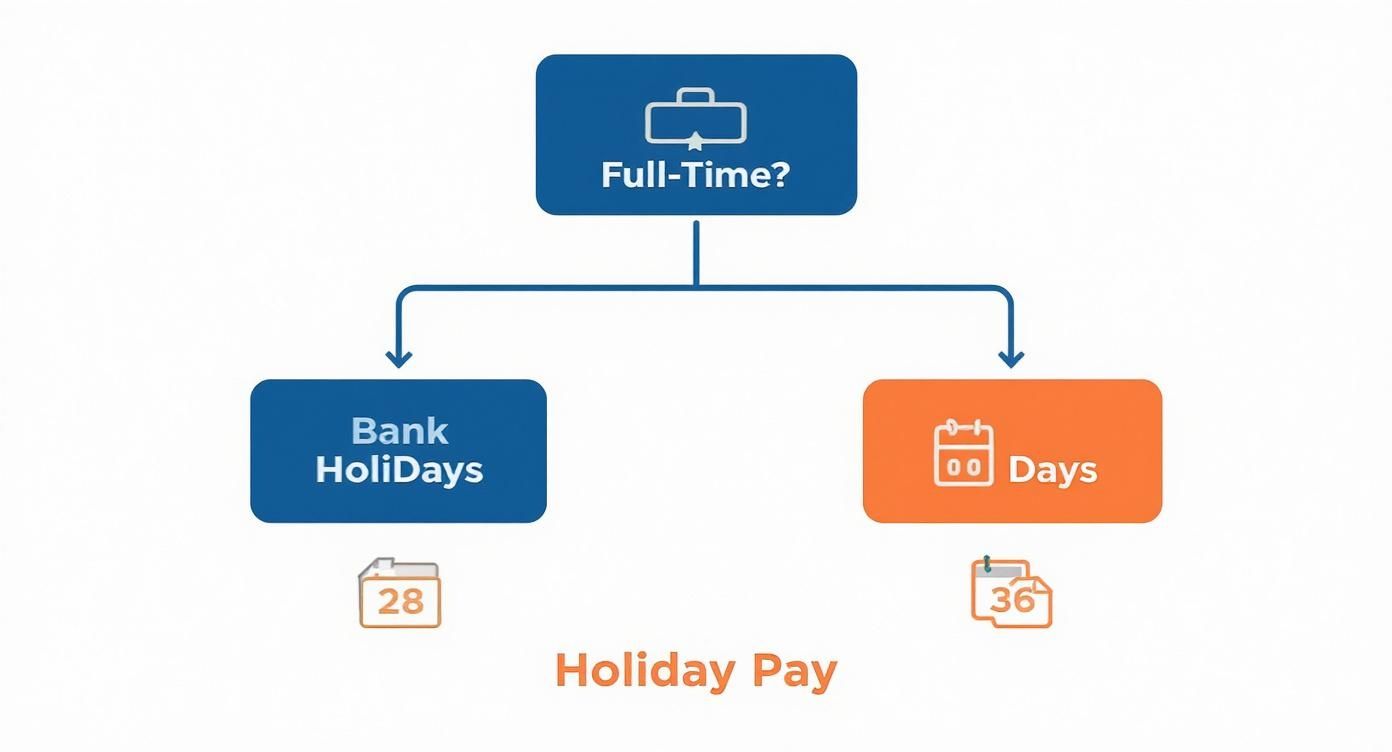
As the infographic shows, that baseline entitlement—often 28 days—is the number we adjust for part-time team members.
Getting the pro-rata calculation right is essential for keeping things fair and consistent for everyone, no matter their working pattern. Whether you work a fixed part-time schedule or more irregular hours, the goal is always the same: ensuring you get an equivalent amount of paid time off.
Working Out Holiday for Irregular and Zero-Hour Contracts
Figuring out holiday entitlement for staff on irregular or zero-hour contracts can feel like a real headache. This is especially true for agency staff, gig economy workers, or anyone whose hours fluctuate week by week. The key thing to remember is that instead of a fixed number of days, their holiday entitlement is based directly on the hours they actually work.
So, how do you do it? The standard approach in the UK is to use the 12.07% accrual rate. This percentage isn't just pulled out of thin air; it comes directly from the statutory 5.6 weeks of leave.
Think of it this way: there are 52 weeks in a year. If you subtract the 5.6 weeks of holiday, you're left with 46.4 working weeks. The 12.07% figure is simply the holiday weeks divided by the working weeks (5.6 ÷ 46.4), which gives you a fair percentage to apply.

This method ensures that for every hour someone works, they earn a proportional amount of holiday time. It’s a reliable way to keep things fair and compliant.
Putting the 12.07% Rule into Practice
Let's look at a practical example. Say one of your team members had a busy month and clocked up a total of 60 hours. To calculate their holiday entitlement, you just multiply their hours worked by the accrual rate.
- 60 hours worked x 0.1207 = 7.24 hours of paid holiday earned.
It's a straightforward calculation you can do at the end of each pay period to keep their allowance topped up. If you're looking for more detail, we have a complete guide dedicated to understanding holiday entitlement on a zero-hour contract.
Key Takeaway: The 12.07% method means that for every 100 hours an employee works, they build up just over 12 hours of paid leave. This keeps their holiday entitlement directly linked to their actual working time.
How Is Their Holiday Pay Calculated?
Accruing the hours is one part of the puzzle, but what about the pay? For workers with irregular hours, you don't use a fixed salary to calculate their holiday pay.
Instead, you need to work out their average pay over the previous 52 paid weeks. It's crucial to only include the weeks they actually earned money and to ignore any weeks they didn't work at all. This average pay then sets the hourly rate for any holiday time they take, ensuring their pay accurately reflects what they normally earn.
What to Do with Unused Leave and When Changing Jobs
So, what happens when you get to the end of the holiday year with a few days left in the bank? Or when you're packing up your desk to start a new role? These are really common situations, and the rules on carrying leave over or getting paid out are things both you and your employer need to get right.
Legally, you have to take at least four weeks of your statutory leave within the year it's earned. But what about the rest? Your employer might let you carry over the extra 1.6 weeks of statutory leave, or any additional contractual days they offer. This isn't a given, though—it’s completely down to company policy, so your first port of call should always be your contract or the staff handbook.
Calculating Your Final Holiday Pay When You Leave
When you hand in your notice, you're legally entitled to be paid for any statutory holiday you've earned but haven't taken. The calculation for this is pretty straightforward and is based on how much of the holiday year you’ve worked.
Here's how it breaks down:
- First, figure out the proportion of the year you've worked. For example, if your last day is exactly halfway through the company's holiday year, you've worked 50% of it.
- Next, apply that percentage to your total annual leave entitlement. If you get the standard 28 days a year, you would have accrued 14 days by that point (28 days x 50%).
- Finally, subtract any holiday you've already taken. If you’ve used 10 days of leave so far, your employer owes you payment for the remaining 4 days in your final pay packet.
A Word of Caution: It works both ways. If you've taken more holiday than you've actually accrued when you leave, your employer is well within their rights to deduct the difference from your final pay. You'll almost always find a clause for this in your employment contract.
This whole process is about making sure you get a fair settlement and are properly paid for the time off you've rightfully earned while you were there.
What About Flexible and Unlimited Holiday Policies?
The world of work has changed dramatically, and so have our ideas about annual leave. Many companies are looking beyond the statutory minimums, ditching the old one-size-fits-all approach to holidays. The whole idea is to treat employees like responsible adults and give them genuine control over their work-life balance.
We're seeing a few popular policies really take hold:
- Unlimited Annual Leave: This policy is built on trust. It lets employees take the time they need to rest and recharge without worrying about a fixed number of days. It's also a massive draw for attracting top talent.
- Duvet Days: Think of these as unplanned, no-questions-asked days off. They're perfect for those moments when you just need a mental health day without any hassle.
- Buying and Selling Holiday: This gives staff incredible flexibility. They can purchase extra days for a big trip or sell back any unused days for a bit of extra cash.
A Surprising Twist in Time Off
These policies sound fantastic on paper, but the reality can be a bit more complicated. It’s a strange paradox, but some studies show that when people are given more freedom, they sometimes end up taking less time off. There's a real concern that in companies with unlimited leave, a subtle pressure builds up, making employees hesitant to take "too much" time, which can ironically lead to burnout.
Recent UK data highlights a fascinating trend. The average annual leave taken actually dropped from 38 days in 2020 to 33.9 days in 2023, even though the statutory minimums didn't change. Heavy workloads and economic uncertainty are often blamed for this. You can dig into more of the numbers by checking out the UK annual leave trends on peoplehr.com.
The Bottom Line: Flexible policies are a brilliant perk, but their success truly depends on the company culture. If leadership doesn't actively encourage people to switch off and take their leave, even the most generous policy won't be enough to prevent burnout.
Common Questions About UK Holiday Pay
Once you've got the hang of the calculations, you'll find that real-life situations often throw up a few tricky questions. Let's tackle some of the most common queries that land in my inbox from both employees and managers.
Can My Boss Dictate When I Take My Holidays?
In short, yes. Your employer can tell you when to take your annual leave, but they have to play by the rules. The key is notice.
They must give you at least double the notice for the length of the holiday they're asking you to take. So, if they want you to take a week off, they need to tell you at least two weeks in advance. This is a common practice for businesses that have a company-wide shutdown, especially over the Christmas break.
What If I Have to Work on a Bank Holiday?
This all comes down to your contract. If your total 28 days of leave includes bank holidays, then working on one just means you have that day to take at another time. It doesn't disappear.
If your employer gives you bank holidays in addition to your standard allowance, they usually have two options: offer you another day off (often called a 'day in lieu') or pay you for the extra day's work.
A Quick Tip: Your employment contract is the single source of truth here. Dig it out and check the specific clause on bank holidays. It will tell you exactly what to expect – a day in lieu or extra pay.
How Does Sick Leave or Maternity Affect My Holiday?
This is a big one, but the answer is simple: your holiday entitlement keeps building up as normal while you're on maternity, paternity, adoption, or sick leave.
You're still legally employed during these periods, so your statutory leave accrues just as if you were in the office. Many people choose to tag their accrued holiday onto the end of their leave to extend their time off, or they arrange with their employer to take it later.
Is There an Official Government Holiday Calculator?
There is! The UK government has a really useful online tool to help you figure out your exact entitlement.
You can find the official holiday entitlement calculator on GOV.UK. It's a great way to double-check your own maths and get peace of mind that you're getting the right amount of paid leave, no matter how complex your working pattern is.
Tired of wrestling with spreadsheets and manual calculations? With Annual Leave Tracker, you can automate holiday calculations, handle requests smoothly, and see who's off at a glance. Start your free trial today and see how much simpler leave management can be.
Ready to Transform Your Leave Management?
Join 500+ companies using Annual Leave Tracker to streamline their HR processes.
Related Articles

How to Calculate Pro Rata Holidays A Simple UK Guide
Working out pro rata holidays is actually quite straightforward. At its core, it's just about making...
September 24, 2025
How to Calculate Annual Leave Entitlement: UK Guide
Figuring out annual leave entitlement doesn't have to be complicated. The basic formula is simple:...
September 24, 2025
HR Systems for Small Business A Complete Guide
Trying to run a small business using spreadsheets and a jumble of different documents is a bit like...
September 25, 2025