 Annual Leave Tracker
A Guide to Calculate Annual Leave in the UK

To work out an employee's annual leave, you first need to know their full entitlement. For a standard full-time UK worker, this is typically 5.6 weeks, which works out to 28 days. From there, you can adjust this figure on a pro-rata basis for part-time staff or for anyone who joins or leaves part-way through your company's holiday year.
Understanding UK Holiday Entitlement
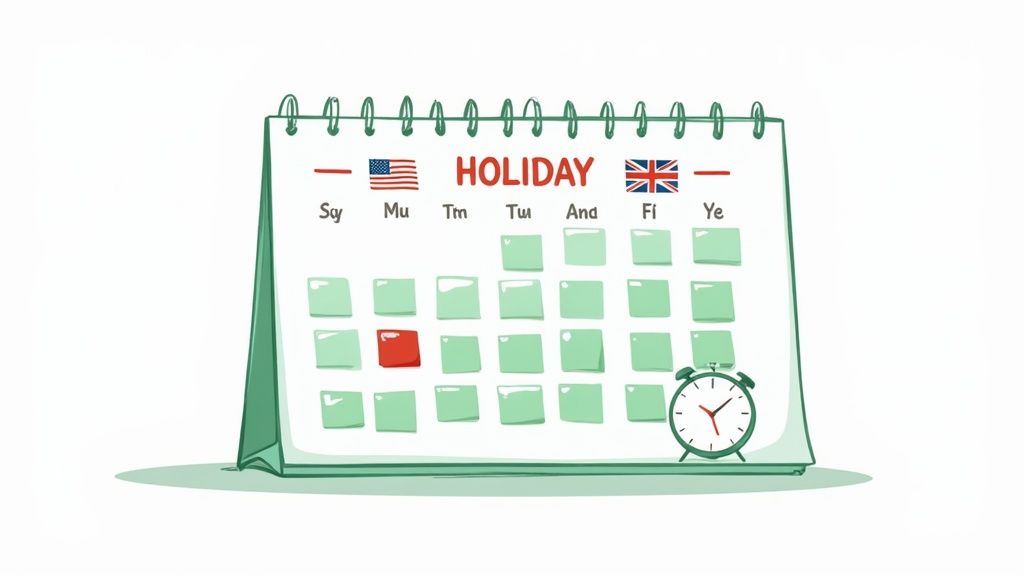
Before you can start crunching the numbers, you have to get to grips with the basics of UK holiday rules. Getting this wrong can quickly lead to payroll headaches and unhappy team members, so a solid understanding of the foundations is essential.
In the UK, the law states that all full-time employees are entitled to a minimum of 28 days of paid annual leave per year. This is equivalent to 5.6 weeks. This statutory minimum includes the standard 20 days of leave plus the 8 UK bank holidays.
Employers do have some flexibility, though. You can decide whether to include bank holidays within those 28 days or offer them as additional days off. How you handle this should be clearly laid out in the employment contract.
Key Principles of Leave Accrual
It’s a common myth that holiday entitlement only starts after a probation period. The truth is, leave starts building up from an employee's very first day on the job. This is a crucial detail for calculating holiday pay correctly, especially for new starters.
For a full-time employee, this accrual works out to roughly 2.33 days for every month they work. This system keeps things fair for everyone, no matter when they join the company. So, if someone starts three months into your holiday year, they’ve already earned a chunk of their annual allowance.
A clear grasp of these statutory minimums is your first step toward fair and compliant holiday management. It cuts out confusion and ensures every employee gets exactly what they’re legally owed.
Part-Time Entitlement Basics
For your part-time staff, the entitlement is calculated on a pro-rata basis. It’s a simple but vital calculation.
Let’s say you have someone who works three days a week. Their leave is a direct proportion of the full-time 28-day allowance. The calculation looks like this: (3 ÷ 5) × 28, which equals 16.8 days. It's always a good practice to round up partial days to the nearest half or full day to be generous and avoid disputes.
For more detailed examples, our complete employee guide on UK holiday entitlement breaks down various working patterns.
To give you a quick reference, here's how the statutory minimum plays out for different weekly work schedules.
| Statutory Annual Leave Entitlement by Work Pattern | | :--- | :--- | | Days Worked Per Week | Minimum Annual Leave (Days) | | 5 | 28 | | 4 | 22.4 | | 3 | 16.8 | | 2 | 11.2 | | 1 | 5.6 |
This table shows the absolute minimum entitlement. Many companies offer more as part of their benefits package, but you can never offer less than these figures.
Here’s how we can break down annual leave calculations for your full-time staff.
On the surface, calculating holiday for a full-timer seems simple. But things get tricky when people join or leave mid-year, which, let's face it, happens all the time. The most reliable method I've found is to stick to a straightforward monthly accrual system.
First, take the total yearly entitlement and divide it by twelve. The UK statutory minimum is 28 days, so that works out to 2.33 days building up each month. This basic calculation is the foundation for keeping everything fair and square.
Of course, not every business sticks to the bare minimum. What if you offer a more generous holiday package?
What if You Offer More Than the Minimum?
Let’s say you offer a competitive 33 days a year (that’s 25 days plus the 8 bank holidays). The logic doesn't change, just the numbers you're working with.
- Your Total Annual Entitlement: 33 days
- Monthly Accrual: 33 days ÷ 12 months = 2.75 days per month
This new figure is what you’ll use to work out pro-rata leave for anyone who isn't with you for the full calendar year.
Imagine a new hire starts on the 1st of April, and your holiday year runs from January to December. They’ll be with you for nine months of that leave year. The calculation would be 9 months × 2.75 days, giving them an entitlement of 24.75 days for the rest of the year.
A quick tip from experience: always round up partial days to the nearest half or even full day. It's a small thing, but it avoids any potential friction and is a great way to show your team you're fair.
Sticking to a consistent monthly accrual method like this means you can calculate annual leave correctly every single time, no matter what your company policy is. It gives you a clear, repeatable process to make sure every full-timer gets exactly what they’re owed, from their first day right up to their last.
Mastering Pro-Rata Holiday Pay For Part-Time Staff
Figuring out annual leave for part-time staff often feels like a headache, but it’s actually quite straightforward once you get the hang of it. Making sure you get this right isn't just about good practice; it's a legal must-have that ensures every team member gets the time off they're entitled to, no matter their working pattern.
The best way to calculate their leave really depends on how they work.
For an employee who works the same part-time days every week, the calculation is simple. You just multiply the number of days they work per week by the statutory 5.6 weeks of annual leave.
So, if someone works a consistent two days a week, their holiday entitlement is 11.2 days for the year (2 days × 5.6 weeks). Easy.
This infographic breaks down the two main methods you'll use, showing the clear difference between handling fixed schedules and variable ones.
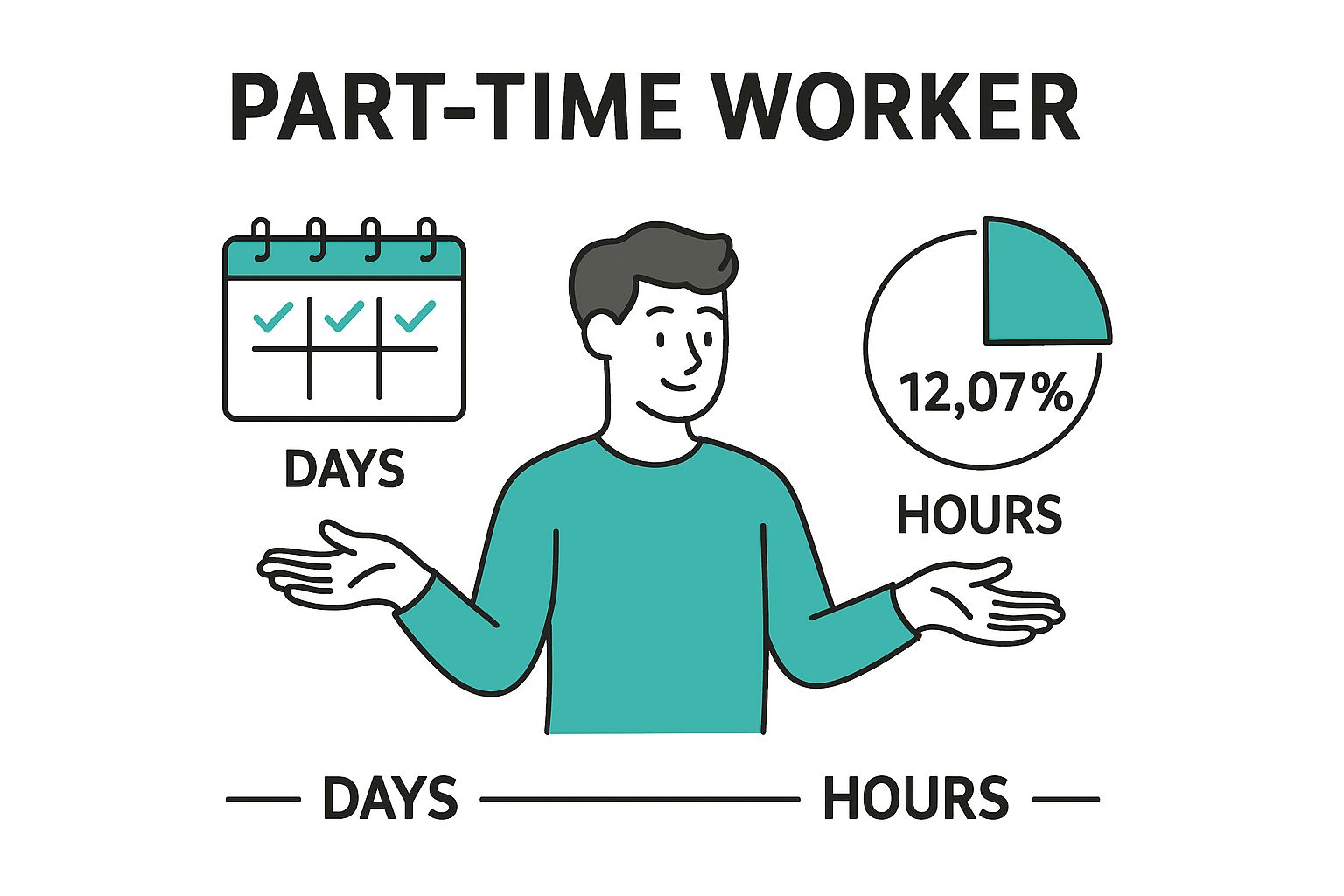
As you can see, the day-based method is perfect for predictable schedules, while the percentage method gives you the flexibility needed for staff with irregular hours.
Tackling Variable and Casual Hours
But what about team members whose hours change week to week? Think casual workers or people on zero-hours contracts. This is where the 12.07% method becomes your best friend.
That percentage isn't just a random number. It’s derived from the statutory 5.6 weeks of holiday, divided by the remaining 46.4 working weeks in a year (52 weeks - 5.6 weeks). Using this calculation ensures their holiday pay is always directly proportional to the hours they’ve actually worked.
To work out their holiday entitlement, you take the total hours they've worked in a pay period and multiply that figure by 12.07%. The result is the amount of holiday they've accrued in hours.
Let's imagine a retail worker on a casual contract logs 50 hours in a month. Their holiday accrual for that period would be:
- 50 hours × 12.07% = 6.035 hours of paid leave
This approach guarantees fairness, meaning even your most flexible team members are compensated properly.
Pro-Rata Calculation Methods Compared
Choosing the right method is key to getting the calculation right every time. Here's a quick comparison to help you decide which one to use.
| Calculation Method | Best For | Example Formula |
|---|---|---|
| Days-Worked Method | Part-time staff with fixed, consistent working days each week. | (Days worked per week) × 5.6 weeks = Annual leave in days |
| 12.07% Method | Casual workers, zero-hours contracts, or anyone with variable hours. | (Total hours worked in a period) × 12.07% = Leave accrued in hours |
Ultimately, both methods get you to the same fair result, but applying the correct one to the right situation makes the whole process much smoother.
If you're dealing with more complex situations or just want to explore this topic further, our guide to calculating pro-rata holiday entitlement is a great resource. Once you’re comfortable with these two pro-rata approaches, you’ll be able to calculate annual leave accurately for any part-time member of your team.
How to Handle Leave for Starters and Leavers
People come and go—it's just a part of running a business. But when they do, it can throw a spanner in the works for your annual leave calculations. Figuring out the final holiday pay for someone leaving, or getting the entitlement right for a new starter, has to be spot on to avoid payroll headaches and potential disputes.
The secret is to pro-rata their allowance. You simply need to work out their holiday entitlement based on the chunk of the year they were actually with you.
For a standard full-time employee on the statutory 28 days, this works out to about 2.33 days of holiday earned each month. So, if someone leaves halfway through the year, they've earned half their total allowance, which is 14 days.
Once you have that number, you just compare it to how much leave they've already taken.
- Taken less than they’ve earned? You'll need to pay them for those unused days in their final payslip.
- Taken more than they've earned? You can usually deduct the overpayment from their final salary, but only if this is clearly stated in their employment contract.
A quick tip from experience: make sure your employment contracts have a clear clause on how holiday pay is handled when someone leaves. It’s a small detail that can save you a world of trouble and misunderstandings later.
What About Staff on Irregular Hours?
When it comes to leavers who didn't work set hours, the 12.07% method is still your most reliable bet. This is particularly important if their pay fluctuated with things like commission or overtime, because their final holiday pay should be based on their average earnings, not just a basic rate.
Let's take a real-world example. Say a zero-hours team member leaves after clocking 150 hours over the past few months. To calculate their final holiday pay, you’d do:
150 hours × 12.07% = 18.1 hours of paid leave.
This calculation makes sure their final pay accurately reflects the hours they actually put in. If you want to dive deeper into these kinds of situations, we've covered them in our guide to understanding holiday entitlement on a zero-hour contract.
Trying to juggle these calculations manually for every person who joins or leaves can be a real drain on your time, not to mention a minefield for potential errors. Having a clear, consistent process is the best way to keep things fair and accurate.
The Bigger Picture on UK Annual Leave Trends

Being able to calculate annual leave entitlements is a fundamental HR skill, but it’s really just the starting point. To truly grasp why it's so important to get holiday tracking right, we need to look at the wider trends happening in UK workplaces. And honestly, the data is a bit concerning.
Put simply, UK employees aren't taking as much time off as they used to. This isn’t just an anecdotal observation; the numbers back it up. Between 2020 and 2023, the average number of leave days taken by a full-time UK employee dropped from 38 to just 34. That’s a fall of nearly 12% in three short years.
Some industries are feeling this more than others. Agriculture saw an 11.85% drop in holiday usage, while construction wasn't far behind with a 10.98% decrease. You can dig deeper into these figures by checking out this UK annual leave report.
So, Why Are People Skipping Their Breaks?
What's behind this shift? It’s rarely one single thing. Usually, it's a mix of economic pressures and the prevailing workplace culture that makes people hesitant to book time off.
- Financial Squeeze: With the cost of living on everyone's mind, some employees would rather 'sell back' unused holiday days for a bit of extra cash, assuming their company policy even allows for it.
- A Culture of 'Always On': In some businesses, heavy workloads and an undercurrent of 'presenteeism' can make team members feel guilty or stressed about stepping away from their desks.
- Job Insecurity: When people are worried about job security, they often work longer and take fewer breaks, hoping to prove their value and commitment.
Understanding these pressures changes how we should think about holiday management. It’s not just an admin task. It’s a core part of supporting employee well-being and tackling burnout head-on before it spirals into a bigger issue.
For anyone in a leadership or HR role, this context is vital. Knowing the maths of accrual is one thing, but the real skill lies in building a culture where your team feels genuinely comfortable and encouraged to use the time off they’ve rightfully earned.
Answering Your Team's Annual Leave Questions
When it comes to annual leave, a few common questions always seem to pop up. Let's tackle them head-on, so you can handle these real-world scenarios with confidence, all based on UK employment rules.
Can staff take holidays during their notice period?
Yes, they can. If an employee has a pre-booked holiday that falls within their notice period, it can usually go ahead. However, you aren't obligated to approve any new holiday requests made after they've handed in their notice.
If they can't take their remaining days off, you'll need to pay them for any unused, accrued leave in their final pay packet.
What's the deal with carrying leave over to next year?
This one is a mix of legal requirements and company policy. Legally, your team must take the first four weeks of their statutory leave within the holiday year.
Anything beyond that, including the remaining 1.6 weeks of statutory leave or any extra contractual leave, can be carried over if your company policy allows it. It’s your call, so make sure your holiday policy is crystal clear on this.
What Happens to Unused Leave?
It’s surprising how much annual leave goes untaken across the UK. The average allowance has hovered around 23 days (plus bank holidays) for a few years, but many people aren't using it all. In 2024, the typical UK worker left about 5 days of holiday on the table. That’s an entire working week.
You can dive deeper into these trends and what they signal for employee wellbeing in this detailed analysis of annual leave statistics.
This pattern of untaken leave isn't just a numbers game. It's a sign that we need to build company cultures where people feel genuinely encouraged to switch off and use the restorative breaks they’ve earned.
What if someone gets sick on holiday?
If an employee falls ill during a pre-booked holiday, they have the right to claim that time back. They can report it as sick leave instead, provided they follow your company’s usual sickness reporting procedure.
You can still ask for a doctor's note for proof, just as you would for any other period of sickness. The holiday days they were ill for can then be rescheduled for a later date.
Tired of wrestling with spreadsheets to get these calculations right? The Annual Leave Tracker automates everything from accruals to final pay, ensuring your team gets exactly what they're owed, every time. Ditch the manual admin and get started at https://www.annualleavetracker.com.
Ready to Transform Your Leave Management?
Join 500+ companies using Annual Leave Tracker to streamline their HR processes.
Related Articles

How to Calculate Pro Rata Holidays A Simple UK Guide
Working out pro rata holidays is actually quite straightforward. At its core, it's just about making...
September 24, 2025
How to Calculate Annual Leave Entitlement: UK Guide
Figuring out annual leave entitlement doesn't have to be complicated. The basic formula is simple:...
September 24, 2025
HR Systems for Small Business A Complete Guide
Trying to run a small business using spreadsheets and a jumble of different documents is a bit like...
September 25, 2025